The Quansight team shares their achievements from the past year collaborating with Meta to advance GIL-free Python, including implementing support in numerous key packages (like NumPy, SciPy, etc.) and project tools, bringing multi-threading performance improvements to CPython 3.14.
TL;DR
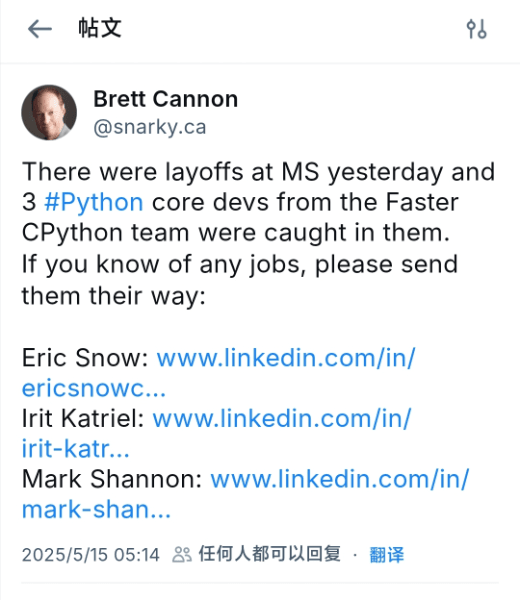
Microsoft's layoffs hit the Faster CPython team, including lead Mark Shannon, causing an uproar; free-threaded Python marks its first year, and ByteDance open-sources the deer-flow deep research framework.
🦄
Articles & Tutorials
× 12An academic paper studying the performance and energy consumption of eight Python compilers (like PyPy, Numba, Codon, etc.) compared to CPython. Results show compilation significantly improves speed, reduces energy consumption, and optimizes memory, with Codon, PyPy, and Numba achieving over 90% improvements, while Nuitka provides stable memory optimization.
Core developer Brett Cannon explains the t-string syntax in Python 3.14. It decomposes string templates into tuples of literals and expressions, allowing developers to customize expression processing logic. (Additional: Detailed explanation of Python 3.14 t-strings)
A rant piece: NumPy is elegant and clear when handling simple arrays, but when working with complex multi-dimensional arrays, its API design is terrible and lacks intuitiveness.
Typerdrive is a library that extends Typer for developing CLI applications that communicate with APIs. By integrating configuration management, caching mechanisms, error handling, HTTP clients, and logging systems, it significantly simplifies the development process and enhances user experience.
After upgrading to Django 5, the author encountered a strange database issue. The article shares the troubleshooting process, discovering the problem stemmed from discrepancies between Django model definitions and actual database schema, particularly primary key type mismatches causing empty querysets.
Explores key techniques for Python application performance monitoring, from basic CPU and memory monitoring to advanced distributed tracing. Shows how to collect critical metrics using tools like psutil and Prometheus, and use visualization to help developers quickly identify performance bottlenecks.
Shares best practices for building production-grade Python projects, from project structure to modern toolchain usage. Examples include using uv, ruff, and other tools to improve development efficiency, achieving environment consistency through Docker. Particularly emphasizes experience in modular design, code organization, testing strategies, and deployment processes.
The author used Python to analyze the SVG data of X company's new logo, comparing it with X characters from multiple fonts. Demonstrates the powerful capabilities of Python tools (like svg.path, matplotlib, and fontTools) in graphics processing and font analysis.
The Attendi team shares challenges and solutions encountered when merging multiple Python projects into a monorepo. They adopted Polylith architecture, dividing code into components, bases, projects, and development sections. Through unified dependency management and simplified code sharing processes, they improved code reusability and development efficiency.
How to implement log tracing in FastAPI projects, especially for distributed services? The article introduces generating unique trace identifiers through middleware, using contextvars to solve log confusion in concurrent requests, and finally combining loguru's log filters to dynamically populate trace information, achieving log tracing in distributed systems.
Cursor achieves efficient codebase indexing through Merkle trees. It first chunks code and calculates hash values, builds tree structures, then syncs with servers. This design allows Cursor to quickly identify changed files, uploading only modified parts, significantly reducing bandwidth consumption. It ensures code security through path obfuscation and local storage, making team collaboration more efficient.
🐿️
Projects & Resources
× 12A community-driven deep research framework that combines language models with specialized tools like web search, content scraping, and Python code execution, while giving back to the community. (10.1K stars)
An AI code optimization tool designed specifically for Python developers, automatically improving code performance while ensuring functional correctness. Already used by teams from well-known projects like Pydantic, Langflow, and Albumentations.
03 Scrapling: An undetectable, powerful, flexible, high-performance Python library to make Web Scraping Easy and Effortless github.com
A high-performance Python web scraping library supporting multiple selectors (CSS, XPath, regex, etc.), automatic similar element location, and intelligent content extraction features. (5.2K stars)
A driver assistance system supporting over 300 vehicle models, providing complete autonomous driving solutions including lane keeping, adaptive cruise control, and other features. (53.8K stars)
A tournament management system based on FastAPI and Next.js, supporting various formats like single elimination, round-robin, and Swiss tournaments. Features drag-and-drop match scheduling, multi-stage tournament structures, team management, multi-club support, etc. Supports Docker deployment and multiple languages. (1.1K stars)
An open-source project dedicated to replicating Manus AI agent capabilities, supporting multi-agent collaboration to autonomously complete complex tasks like travel planning, data analysis, and content generation. Uses modular and containerized design, integrating various tools like web browsing and code execution.
Based on asyncio and anyio, supports multiple backends (Redis, Postgres, MongoDB), providing advanced features like delayed tasks, scheduled tasks, error retry, and dead letter queues. Built-in rate limiting and concurrency control, supports task progress reporting and event hooks, seamlessly integrates with ASGI frameworks like FastAPI.
An innovative framework open-sourced by Alibaba DAMO Academy that enhances large models' search capabilities through reinforcement learning without actually calling search engines. Uses simulated search for training, gradually improving model reasoning capabilities through curriculum learning mechanisms.
Collects leaked system prompts from multiple mainstream large models, including latest versions of ChatGPT, Claude, Gemini, Grok, and other models. Very valuable for researching large models' internal mechanisms and developing related applications. (4.6K stars)
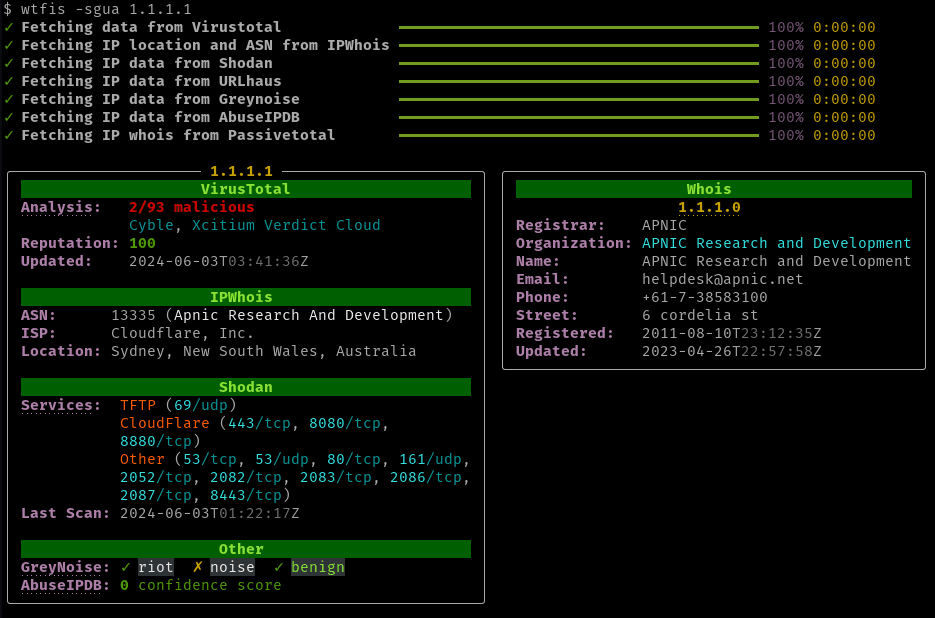
A beautiful command-line tool that integrates multiple OSINT services (like Virustotal, Shodan, Greynoise, etc.) to collect information about domains, FQDNs, and IPs. Supports various data sources including malware detection, geolocation, open ports, and other information. (1.5K stars)
Powerful content automation tool supporting processing of torrents, newsgroups, podcasts, comics, TV shows, movies, and other content types. Obtains content through RSS feeds, HTML pages, CSV files, search engines, and other sources, providing a rich plugin system. (1.8K stars)
A file manager for terminals, particularly suitable for use in Termux environments. Supports Vim-style shortcuts, provides basic functions like file copying, moving, renaming, as well as advanced features like file search and property viewing. Supports custom themes, shortcuts, and commands. (748 stars)
🐢
Podcasts & Videos
× 2This year's PyCon has begun, but devastating news has spread throughout the Python community: Microsoft laid off 3 core developers from the Faster CPython team, including the project's proposer. Python's creator Guido is also on this team but wasn't laid off.
Before the beta release of Python 3.14, two core developer hosts discussed some of the major new features.
🥂