A fresh proposal that's got everyone talking! PEP-798 suggests expanding the syntax for list, set, and dictionary comprehensions by allowing unpacking operators * and ** at the beginning of expressions. This enables elegant merging of any number of iterables. Compared to traditional nested loops or itertools.chain approaches, the new syntax [*it for it in its] is way more intuitive and clean.
TL;DR
The Python community welcomes a new generation of AI-era programmers; CPython 3.14's remote debugging protocol gets explored, Alibaba ships Qwen3-Coder, and gitingest feeds whole repos to LLMs.
🦄
Articles & Tutorials
× 13The cereggii library's AtomicDict brings thread-safe dictionary operations to the table, implementing race-free multithreaded aggregation through its reduce() method. Compared to regular dicts, AtomicDict.reduce_sum() delivers a 30% performance boost in single-threaded scenarios and an impressive 5x speedup with 4 threads.
This PEP proposes introducing a unified profilers module that consolidates existing performance analysis tools. The new module offers profilers.tracing (a cProfile alias) and profilers.sampling (featuring the new tachyon sampling profiler), while deprecating the aging profile module for cleaner tool selection.
metap brings serious Python meta-programming firepower with three core capabilities: program enhancement, code generation, and structural introspection. Through a straightforward client API, it enables dynamic type checking, logging, and custom macros, supporting automated coding patterns that boost code maintainability.
Python 3.14 introduces the sys.remote_exec feature, allowing you to inject code execution into running Python programs. No more restarts needed for debugging and status checks – this provides a standardized solution for building development debugging tools.
Django ORM's lazy loading mechanism can easily lead to N+1 query nightmares. The fix? Use select_related() and prefetch_related() methods effectively – the former works great for single-value relationships, while the latter handles multi-value relationships like a champ.
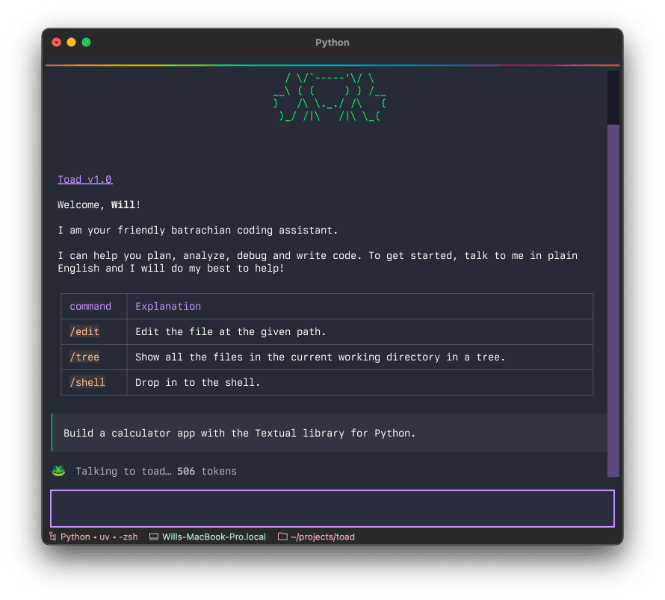
The Textual founder has built Toad using Python and Textual to tackle the flickering and interaction issues plaguing existing terminal AI coding tools (like Claude code and Gemini CLI). It delivers flicker-free updates, text selection, and smooth scrolling that actually works.
A comprehensive breakdown of 2025's hottest Python packaging tools: lightning-fast Rust-powered uv, structured project favorite Poetry, tried-and-true pip, simplified Pipenv, complex project powerhouse Hatch, and standards-first PDM. (Shared by @Wardah Awais)
Flask creator Armin Ronacher is calling on the Python community to embrace the new generation of developers who are getting into programming through AI tools. He argues that AI won't shrink the programmer pool – instead, it'll bring more people into the coding world. The Python community should actively welcome these "vibe coders," offering guidance and support while helping them avoid getting locked into commercial tools.
A deep dive into the "Parse, don't validate" programming principle and how it applies in Python. The article explains that parsing is essentially validation with understanding – by transforming low-level data into high-level structured types, you get convenience and safety while establishing trust boundaries between code sections. It covers solutions ranging from simple NewType to full Pydantic implementations.
When Python scripts output massive amounts of data and pipe it to commands that only read partial content, you'll hit the dreaded BrokenPipeError. The article breaks down exactly why this happens: the receiving end closes the pipe early, triggering a SIGPIPE signal. It offers two elegant solutions – try/except wrapping and context managers – that redirect output to /dev/null to prevent program crashes.
PyCharm's full-line code completion uses local AI models to intelligently suggest log statements, eliminating the cognitive overhead of writing f-string logs. The feature runs on a 100M parameter Transformer model, quantized down to 100MB and specifically optimized for Python code, dramatically boosting debugging efficiency.
This article uses "absolute time" and "civil time" concepts to explain the mind-bending complexity of time handling in programming. From Unix timestamps to UTC standards, leap second adjustments, and timezone conversions, it systematically breaks down how time is represented in computer systems, helping developers understand why "just use UTC" isn't the silver bullet solution.
🐿️
Projects & Resources
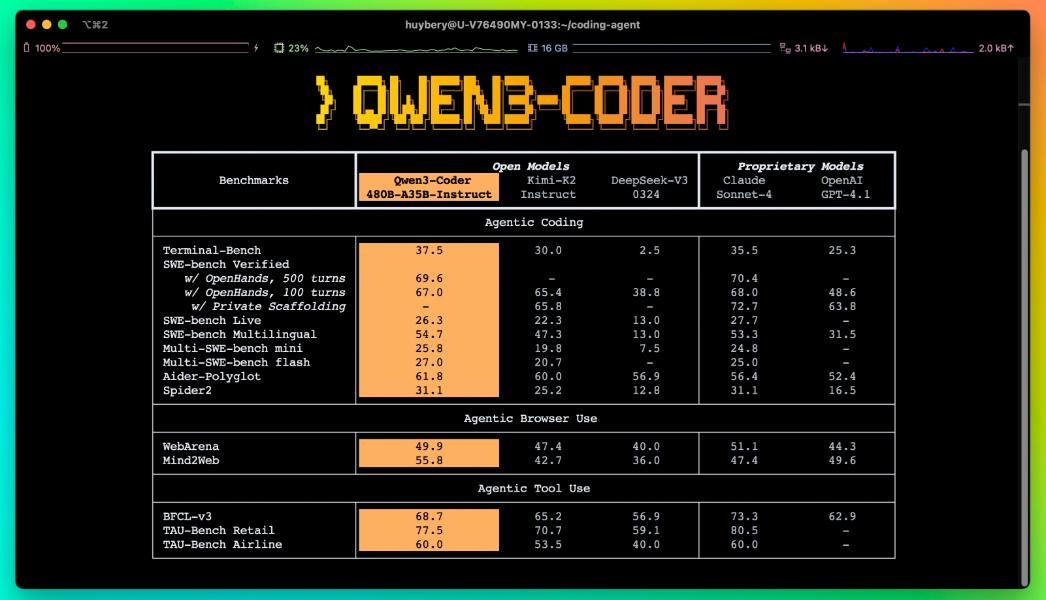
× 12 01 Qwen3-Coder: Qwen3-Coder is the code version of Qwen3, the large language model series developed by Qwen team, Alibaba Cloud. github.com
A Qwen large model that supports AI agent programming. This mixture-of-experts model achieves best-in-class performance among open-source models for AI agent programming, browser usage, and tool utilization, rivaling Claude Sonnet. (9.1K stars)
02 awesome-claude-code: A curated list of awesome commands, files, and workflows for Claude Code github.com
Packed with slash commands, CLAUDE.md files, CLI tools, and other resources to supercharge your Claude Code workflow, productivity, and overall experience. (6.7K stars)
An open-source deep research AI agent from the LangChain team that conducts thorough information gathering and analysis. Features multi-dimensional scoring systems and batch evaluation capabilities. Customize research workflows and model behavior through Web UI, environment variables, or direct config modifications. (6.3K stars)
A high-performance Photoshop file parser built on C++20 with Python bindings. Supports layer editing, smart objects, and more – reading files 5-10x faster than Photoshop itself and writing 20x faster.
An embedded retrieval engine designed for multimodal AI, supporting vector search, full-text search, and SQL queries. Can store and search petabyte-scale multimodal data with deep integrations for LangChain, LlamaIndex, and more. (7.1K stars)
A sleek library for managing your local TV shows and movies. Serves as an alternative to Sonarr, Radarr, and friends, with TVDB and TMDB metadata support, Docker deployment, and API interactions.
A fun Python F-String knowledge site featuring 26 questions that test your understanding of f-string behavior in Python 3.13. Includes keyboard shortcuts and progress saving – perfect for leveling up your f-string game!
08 complexipy: An extremely fast Python library to calculate the cognitive complexity of Python files, written in Rust. github.com
A Rust-powered Python code complexity calculator that supports command line, GitHub Actions, VSCode extensions, and pre-commit hooks. Features CSV/JSON export and customizable threshold settings.
An open-source reinforcement learning framework for training multi-step AI agents using the GRPO algorithm. Supports various models like Qwen and Llama, features a RULER zero-shot reward system that eliminates the need for manual reward function design. Includes client-server architecture with support for remote training and local GPU deployment. (3.6K stars)
A desktop AI personal assistant that actually gets things done – controlling mouse and keyboard, browsing the web, filling forms, sending emails, and more. Supports Claude, GPT-4, Azure OpenAI, and other models with a FastAPI + Electron + React architecture and modular agent system.
The first open-source video generation model using autoregressive diffusion forcing architecture, supporting infinite-length video generation. Offers text-to-video, image-to-video, and video extension capabilities with models ranging from 1.3B to 14B parameters, supporting 540P and 720P resolution output. (3.6K stars)
Supports multiple usage methods including command line, Python package, and browser extensions. Generates text summaries of codebases from GitHub URLs or local directories, complete with file structure statistics and token counting features. (11.2K stars)