Astral introduces pyx, a Python-native package registry that's more than just a traditional package repository—it's an optimized backend for uv. Through vertical integration of client and server, it tackles pain points like PyTorch installation difficulties, redundant package development across teams, and version compatibility issues. Features include GPU awareness, private package hosting, and public source acceleration.
TL;DR
Astral launches pyx, a Python-native package registry now in beta; DeepSeek-R1 takes a shot at optimizing one of the world's oldest codebases, and HRT's Python fork leverages PEP 690 for faster imports.
🦄
Articles & Tutorials
× 12This tutorial explains how to use pytest's parametrize decorator, demonstrating through examples how to eliminate code duplication. Starting from basic multiple test functions, it progressively shows how to use @pytest.mark.parametrize to parameterize test data, reducing code redundancy while improving test maintainability.
HRT's blog shares their Cinder-based lazy import mechanism that defers module resolution and evaluation until actual reference, significantly reducing startup time. The solution uses LazyImport placeholder objects to replace immediate import execution, solving the excessive import overhead problem in large codebases.
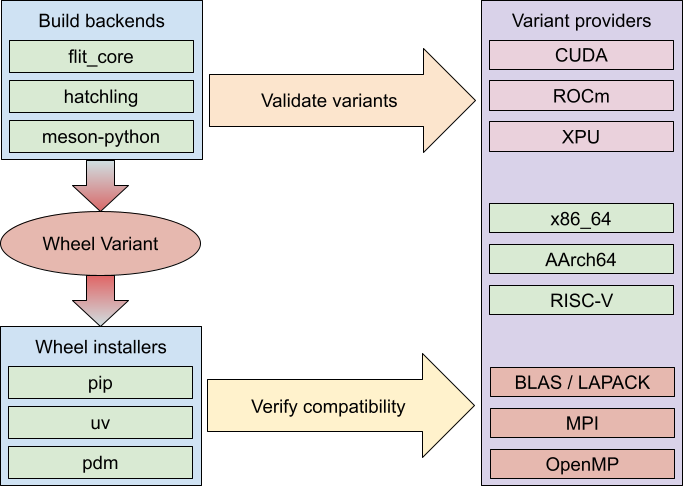
Introduces Python Wheel variant mechanisms that replace traditional platform tags with plugin architecture to handle complex package distribution needs. Using namespace attributes and JSON metadata to describe package variants, it solves issues like GPU acceleration, CPU architecture, and numerical library selection, enabling complex packages like PyTorch to distribute different versions more flexibly.
05 7 Drop-In Replacements to Instantly Speed Up Your Python Data Science Workflows developer.nvidia.com
NVIDIA's blog introduces 7 GPU acceleration solutions that boost performance for pandas, Polars, scikit-learn, XGBoost, and other libraries through simple parameter settings or extension loading. You can achieve significant speed improvements without modifying existing code.
06 Can DeepSeek-R1 improve the performance of one of the worlds oldest codebases? tonybaloney.github.io
The author uses DeepSeek-R1 to optimize 20-year-old big integer arithmetic code in CPython's kernel. Through multiple experiments with models ranging from 70B to 371B parameters, the AI demonstrated both remarkable optimization insights and embarrassing blunders that crashed Python entirely.
The author developed a pypcode-based assembly verification tool that enables semi-automated verification of binary code by adding inline comments to assembly code to define preconditions, assertions, and postconditions.
This article analyzes the design issue of Python package installation paths being tied to versions. While this mechanism solves bytecode and C ABI compatibility problems, it forces all packages to be reinstalled when upgrading Python versions.
Reviews Python's community development journey from its 1991 birth to becoming the world's most popular programming language. Starting with a 20-person gathering in Maryland in 1994 that formed the real community, it went through key milestones like failed early commercialization attempts and foundation organizational structure exploration, emphasizing the crucial role of community values and human connections in Python's success.
This newly released PEP proposes an empty set syntax {/} that mimics the mathematical symbol ∅ to solve the current problem where empty sets can only be constructed with set(). This syntax avoids name lookup and improves the learning experience for beginners, especially being more friendly to users with mathematical backgrounds. It has received 41% support in community voting and is planned for implementation in Python 3.15.
Microsoft introduces the SQL Server Python driver mssql-python, which uses DDBC direct connection architecture and PyBind11 binding technology to achieve 2-4x faster performance than pyodbc in core SQL operations, 8.6x faster bulk inserts, and 16.5x faster creation of 1000 connections.
This tutorial demonstrates how to create professional annotated area charts with plotnine, showcasing the complete workflow from data preprocessing to chart beautification through coal production data visualization. The article covers advanced techniques including custom grid lines, multi-layer annotations, color configuration, and font management.
🐿️
Projects & Resources
× 12A high-precision document conversion tool that supports converting PDF, images, PPTX, DOCX, XLSX, HTML, EPUB, and other formats to markdown, JSON, and HTML. It can format tables, formulas, inline math, links, and code blocks, extract and save images, and remove headers and footers. (27.6K stars)
A browser automation framework that combines natural language and code, supporting four core functions: act (perform actions), extract (data extraction), observe (page observation), and agent (multi-step tasks). Features operation preview and caching, with integration for OpenAI and Anthropic's computer use models.
An open-source digital signage platform for Raspberry Pi and PC. Supports multiple Raspberry Pi models and is compatible with balenaOS and Raspberry Pi OS. Provides a complete digital signage solution suitable for commercial displays, information publishing, and other scenarios. (3.1K stars)
A modern YouTube downloader based on PySide6, supporting video downloads in any quality, audio extraction, subtitle retrieval, SponsorBlock ad removal, playlist downloads, and more. Features a clean graphical interface with advanced capabilities like format tables, multi-subtitle selection and merging, thumbnail saving, and video trimming. (1.8K stars)
A carefully curated list of LLM API resources covering multiple platforms including OpenRouter, Google AI Studio, NVIDIA NIM, Mistral, Groq, Cerebras, and more. Provides detailed information on usage limits, supported models, and access methods for each service. (4.7K stars)
A general-purpose biomedical AI agent developed by Stanford that combines large model reasoning, retrieval-augmented planning, and code execution capabilities. Supports various biomedical research tasks including CRISPR screening design, single-cell RNA sequencing annotation, ADMET property prediction, and more. Provides web interface and MCP protocol support. (2K stars)
07 genai-processors: GenAI Processors is a lightweight Python library that enables efficient, parallel content processing github.com
A lightweight Python library developed by Google Gemini for building modular, asynchronous, and composable generative AI pipelines. Designed around the Processor concept, it supports streaming processing, parallel execution, chain composition, and handles multimodal data including text, images, and audio. (1.9K stars)
An intelligent data query system that supports natural language to SQL conversion. Ready to use out of the box—just configure the large model and data source. Easy to integrate with third-party systems, supporting calls from platforms like n8n, MaxKB, Dify, Coze, and more. Provides workspace resource isolation and fine-grained permission control.
Combines AI agents with traditional scripting, supporting structured output, stealth browser sessions, hybrid workflows, credential management, and digital identity features. Can reduce costs by over 50% while improving reliability. (1.5K stars)
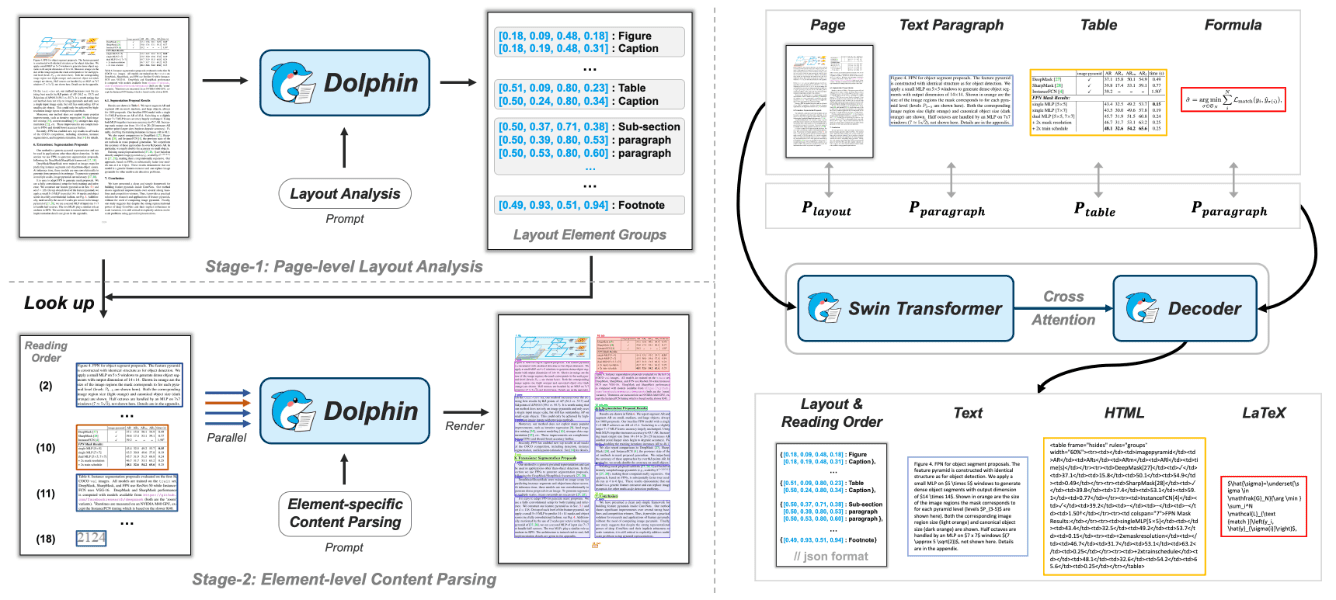
An open-source multimodal document image parsing model from ByteDance that uses a two-stage analyze-parse approach. Efficiently handles various document elements including text, tables, and formulas, offering both Hugging Face and native framework inference options. (5.5K stars)
11 open-notebook: An Open Source implementation of Notebook LM with more flexibility and features github.com
A privacy-first alternative to Google Notebook LM with multimodal content organization, professional podcast generation, intelligent search, and contextual conversation capabilities. Offers complete data sovereignty, cost control, unlimited customization, and API access, supporting Docker deployment and local execution. (3.4K stars)
An all-in-one web scraping framework that can bypass various bot detection systems like Cloudflare, BrowserScan, Fingerprint, and more. Supports humanized mouse movements, desktop app conversion, website interface development, and proxy cost savings up to 97%. Provides simple parallelization, configuration files, extensions, and proxy setup, with integrated caching, sitemaps, data cleaning, and other practical tools. (2.8K stars)