Three new Rust-powered Python type checkers emerged in 2025: Astral's ty, Meta's pyrefly, and David Halter's zuban. The author conducted an in-depth analysis using Python's type conformance test suite to compare these newcomers against established tools like mypy and pyright. While zuban leads in test pass rates, ty shows greater promise for tool quality and gradual adoption strategies.
TL;DR
Ty, Pyrefly, and Zuban go head-to-head in a conformance comparison; eBPF gets written in pure Python, Playwright races Pydoll end-to-end, and LEANN claims to be the world's smallest vector index.
Articles & Tutorials
× 13The author benchmarked Playwright against the emerging pydoll testing framework in their project, finding Playwright significantly outperformed pydoll with shorter execution times and better stability. Despite pydoll's faster Chrome DevTools Protocol foundation, it required 40% more code in practice, lacked built-in features, and only supported Chromium browsers—making it not quite ready for prime time.
PythonBPF enables developers to write eBPF programs using pure Python syntax, replacing traditional C code string embedding with decorators and type annotations. The library compiles Python code into genuine eBPF object files, supporting core features like hash maps, control flow, and kernel tracing—offering a third production-ready option for eBPF development alongside Rust and C.
PEP 804 proposes a central registry mechanism for automatically mapping Python packages' external dependencies to corresponding package names across different package managers. Building on PEP 725's external dependency metadata, this proposal uses standardized mapping rules to solve package name inconsistencies across Linux distributions, conda, Homebrew, and other ecosystems, boosting cross-platform build success rates.
The author analyzes three approaches to writing Django views, pointing out that while generic class-based views are powerful, they hide too much complexity—requiring understanding of up to 11 methods and 5 class inheritance relationships. They recommend using only the base View class, organizing code by separating logic according to HTTP methods, avoiding large if-blocks in function-based views while maintaining code simplicity and readability.
Feature flags let developers dynamically control code functionality without redeployment. This article covers Python implementation approaches, from simple if-statement checks to complete storage architectures using django-waffle, and elegant FeatureFlags class designs. It details multi-dimensional flag strategies including user-level, team-level, and percentage rollout configurations.
Python 3.14 is coming with a new sys.remote_exec() function that can inject code execution into running Python processes without requiring program restarts for debugging. The article demonstrates how to inject traceback.print_stack() to view call stacks or use remote_pdb to establish interactive debugging sessions.
The author downloaded over 60,000 GIF files from the Internet Archive's GeoCities collection, using Python's imagehash library for perceptual hash deduplication and the vit-base-nsfw-detector model to filter inappropriate content. The result is a fully browser-rendered Canvas animation that stitches random GIFs into a scrolling mosaic with CRT shader effects.
Using the metaphor of a blacksmith's hammer, this article analyzes the dangers of unquoted strings in Python, explaining the root cause of CVE-2024-9287. When using subprocess with shell=True, spaces and semicolons in paths get misinterpreted by the shell as command separators, leading to command injection attacks. The recommended solutions are using subprocess.run([...]) to avoid shell parsing or properly quoting strings with shlex.quote.
The author shares techniques for combining Playwright and pytest in end-to-end testing, using page.expect_page() to handle new tab testing and pytest markers instead of fixtures to distinguish different user contexts. The article also covers page.pause() debugging tools, the axe-playwright-python package for preventing accessibility regressions, and page.expect_response() for confirming background requests.
This article compares Rye language's table operations with Python/Pandas for data processing, showcasing how Rye achieves clean data transformations through pipeline operators and pure functions. Rye's tables are first-class immutable data structures supporting chained operations, offering more concise syntax than pure Python for complex data tasks like filtering, joining, and aggregation, with more intuitive syntax compared to Pandas.
Reddit's former infrastructure lead shares the evolution from traditional task queues to durable queues, solving data loss issues by persisting checkpoint state to databases like Postgres. Durable queues combine task queues with durable workflows, enabling recovery from the last completed step for failed tasks, providing built-in observability perfect for business-critical tasks.
The author reveals a little-known battle of content syndication standards, where Microsoft and other giants' ICE standard—despite being more powerful—was too complex and expensive, ultimately losing to simple, open RSS. RSS could create feeds with just three elements, while ICE required a 58,000-word getting-started guide. This technical battle proved the internet's iron law: "simple, open protocols beat complex, top-down solutions."
Projects & Resources
× 13An innovative vector database that transforms laptops into powerful RAG systems, capable of indexing and searching millions of documents while saving 97% storage space compared to traditional solutions without sacrificing accuracy. (⭐ 2.6K)
Microsoft's open-source AI agent training platform that supports transforming any agent into an optimizable powerhouse with virtually zero code changes. Compatible with all major agent frameworks like LangChain, OpenAI Agent SDK, AutoGen, CrewAI, and more, featuring reinforcement learning and automatic prompt optimization algorithms. (⭐ 1.5K)
A real-time AI voice chat system for natural conversations with large language models, delivering near-instant voice responses. Features voice capture, real-time transcription, AI processing, speech synthesis, and intelligent interruption capabilities for smooth conversational experiences. (⭐ 3.1K)
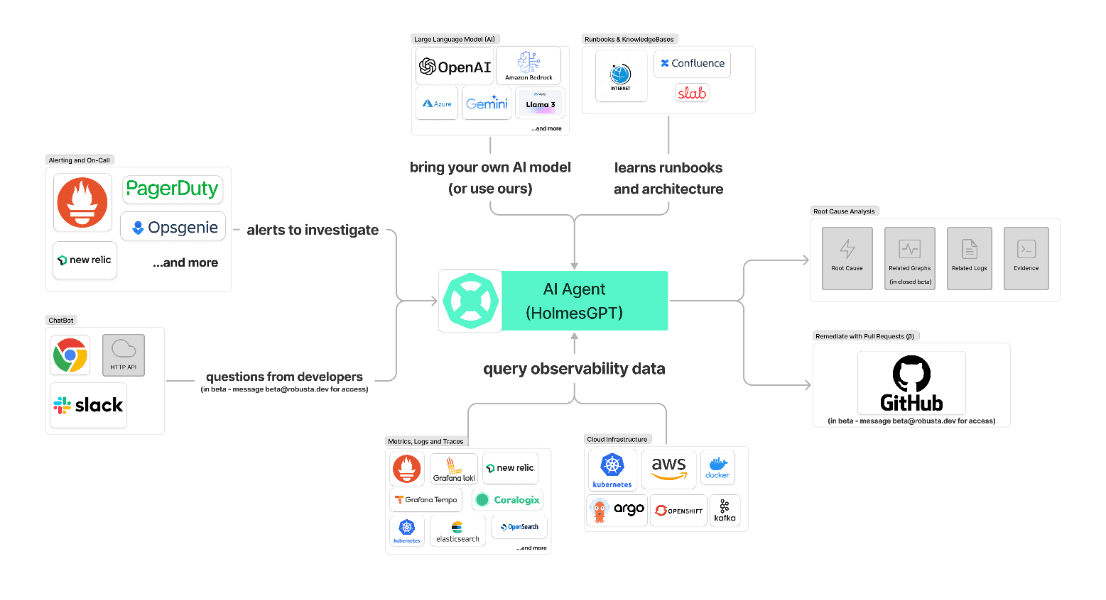
A specialized AI agent for cloud environment troubleshooting and alert investigation that automatically identifies root causes and provides fix recommendations. Integrates with dozens of cloud providers, observability tools, and on-call systems, supporting mainstream platforms like Kubernetes, Prometheus, and DataDog. (⭐ 1.3K)
An end-to-end autonomous research workflow platform that assists researchers through specialized LLM agents in completing the entire research process from literature review and experiment planning to report writing. Supports three core phases: literature review, experiment execution, and report generation, integrating tools like arXiv, Hugging Face, Python, and LaTeX. (⭐ 4.9K)
NVIDIA's scalable generative AI framework supporting seamless training from single GPUs to thousand-node clusters, integrating cutting-edge technologies like Hugging Face models, Blackwell training, and Cosmos world foundation models. (⭐ 15.7K)
A production-grade RAG (Retrieval-Augmented Generation) platform combining graph RAG, vector search, and full-text search technologies, equipped with advanced AI agents. Supports multimodal document processing, hybrid retrieval engines, MCP protocol integration, and enterprise-level management features.
A comic and ebook conversion tool optimized for e-ink readers, supporting conversion of JPG/PNG/GIF image folders, CBZ/CBR archives, and PDFs to MOBI/AZW3, EPUB, KEPUB, CBZ formats. Features image processing optimization tailored for E-ink screen characteristics, significantly reducing file sizes while maintaining visual quality, with support for Kindle, Kobo, reMarkable, and other devices. (⭐ 4.2K)
Alibaba's Tongyi Lab's deep information search AI agent powered by a 30.5 billion parameter language model that activates only 3.3 billion parameters per token. Specifically designed for long-term deep information search tasks, excelling in multiple agent search benchmarks with support for both ReAct and IterResearch reasoning modes. (⭐ 9.1K)
A lightweight AI agent memory backend using Git version control to track memory evolution, Markdown files for human-readable content storage, BM25 indexing for fast retrieval, and support for temporal difference analysis and context management.
A high-performance Python Markdown parser with full CommonMark specification support, featuring configurable syntax rules, plugin extension system, high-speed parsing, and security configurations. It's the Python port of the JavaScript markdown-it library.
A Django interactive component framework built on the htmx.org technology stack, supporting state management, event handling, user authentication, and component subscription mechanisms. Uses Redis for session storage and provides a development experience similar to Phoenix LiveView.
A library that lets Go services call Python code like local functions without requiring CGO or microservice architecture. Implements inter-process communication through Unix Domain Sockets, providing zero network overhead, process isolation, and true parallel processing capabilities.